Fordham Misleads Again
No surprise there. But disappointing to see an OSU professor do it in furtherance of school privatization.


It’s been awhile, Fordham.
I have a history with the Fordham Institute — even penning a joint blog with one of the organization’s researchers some time back.
So I decided to take a look at what they’ve been doing recently. And lo, and behold, Ohio State University Political Science Professor Vladimir Kogan just wrote about how we shouldn’t blame EdChoice tuition subsidies for school district financial problems.
You’ll never guess who he blames. Of course. It’s those greedy school districts again. As it always is with these people.
See, Ohio school enrollment has dropped over the last 15 years and school district employment has ticked up at the same time. Must be greed, not need, right?
Let’s debunk Prof. Kogan’s alleged “debunking” of public school advocates’ arguments in turn. I gotta admit. I kinda miss doing this!
First things first
Let me say right off the top that Ohio’s own school funding formula says that Ohio students are receiving about $2.7 billion fewer state dollars than they need … even with the enrollment drop! So the enrollment thing isn’t even really a thing because the state’s formula quite literally IS the thing.
One more item. 2010 was the height of the Great Recession. I know. I was there. In the legislature. Writing the state’s school funding formula. We had to cut state funding for schools that year because we had no money. Federal money saved the day.
So to use 2010 as a starting point as Kogan does throughout his piece is nuts. Because the assumption he’s making is that our fiscal house was in order then and isn’t now.
In fact, the economic situation today is far better than 2010 when we were literally losing $250 million a month in income tax revenue.
You know how else I know we’re better off economically today than 2010? Because the Evidence Based Model of school funding I drafted was $3 billion short of what students needed. So we proposed a 10-year phase in of the EBM. The Fair School Funding Plan phase in — for less money than EBM — was supposed to be 6 years.
So Kogan’s whole assumption here than 2010 was a reasonable baseline is bonkers to me, as someone who was actually there doing this stuff, because staffing levels from 2010 were, um, understaffed to begin with!
So you can’t say the staffing levels in 2010 were great and now we’re overstaffed or something … because schools have been understaffed, according to the state’s own funding formulas, for each of those 15 years!
Anyway, let’s have some fun with his argument, shall we?
Point #1: Ohio’s declining enrollment should mean declining cost
This enrollment drop thing does a lot of Kogan’s heavy lifting. He says that while school district enrollment has dropped by 15 percent between 2010 and 2025, district employment has increased by 3 percent.
See?
There isn’t a 1:1 ratio, guys, so something nefarious or at least fiscally irresponsible is happening because employment hasn’t dropped by the same (or very nearly the same) percentage!
As ridiculous as that sounds, if you think about it for a even a scant moment, that’s exactly what this actual Ohio State Professor is arguing. Though, I suppose we should give him credit for not saying it directly. He’s merely implying that school districts should see an equal, or substantially equal, drop in their employees.
See, here’s the thing. This Ohio State Professor doesn’t know how to count kids.
I swear to God. He doesn’t know how to count.
Which is why when you actually look at enrollment numbers, here’s what you get:
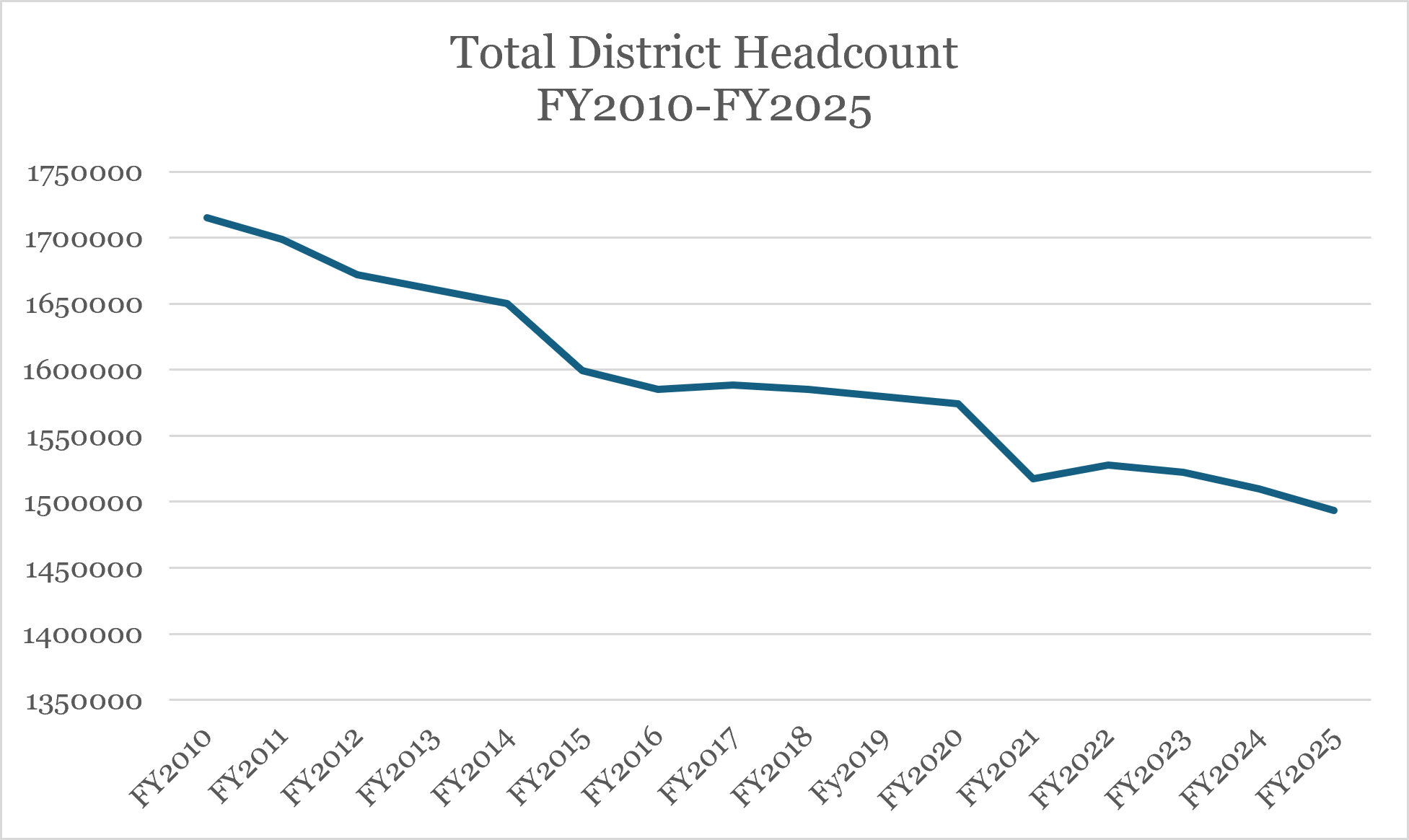
That’s a 12.9 percent enrollment drop, not the 15 percent Kogan mentions. Why is Kogan’s number so much lower? Because he used Average Daily Membership, not headcounts for the last few years. ADM is always lower than actual enrollment for a variety of accounting reasons I won’t bore you to explain1. However, even the Ohio Department of Education’s2 spreadsheets warn researchers that “This data is NOT equivalent to the ADM (average daily membership) that is used for funding purposes.”
Yes. The Department put NOT in ALLCAPS. So you wouldn’t miss it.
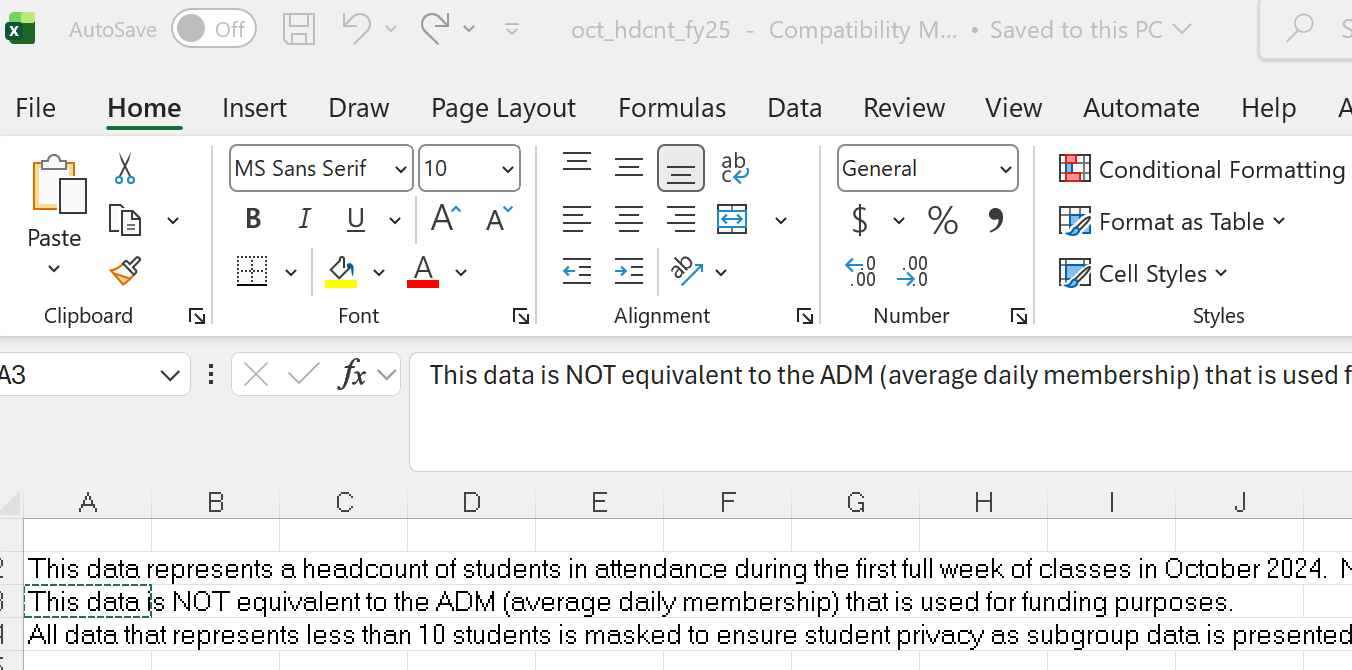
Yet this OSU Prof did. He missed the ALLCAPS (or he didn’t bother getting each spreadsheet, instead relying on AI bots or something?)
So he artificially lowered the last few years’ public school district enrollment to inflate the enrollment drop by a couple percentage points.
Why would he do that?
Well, here’s the population of people age 5 to 17 for those same years:
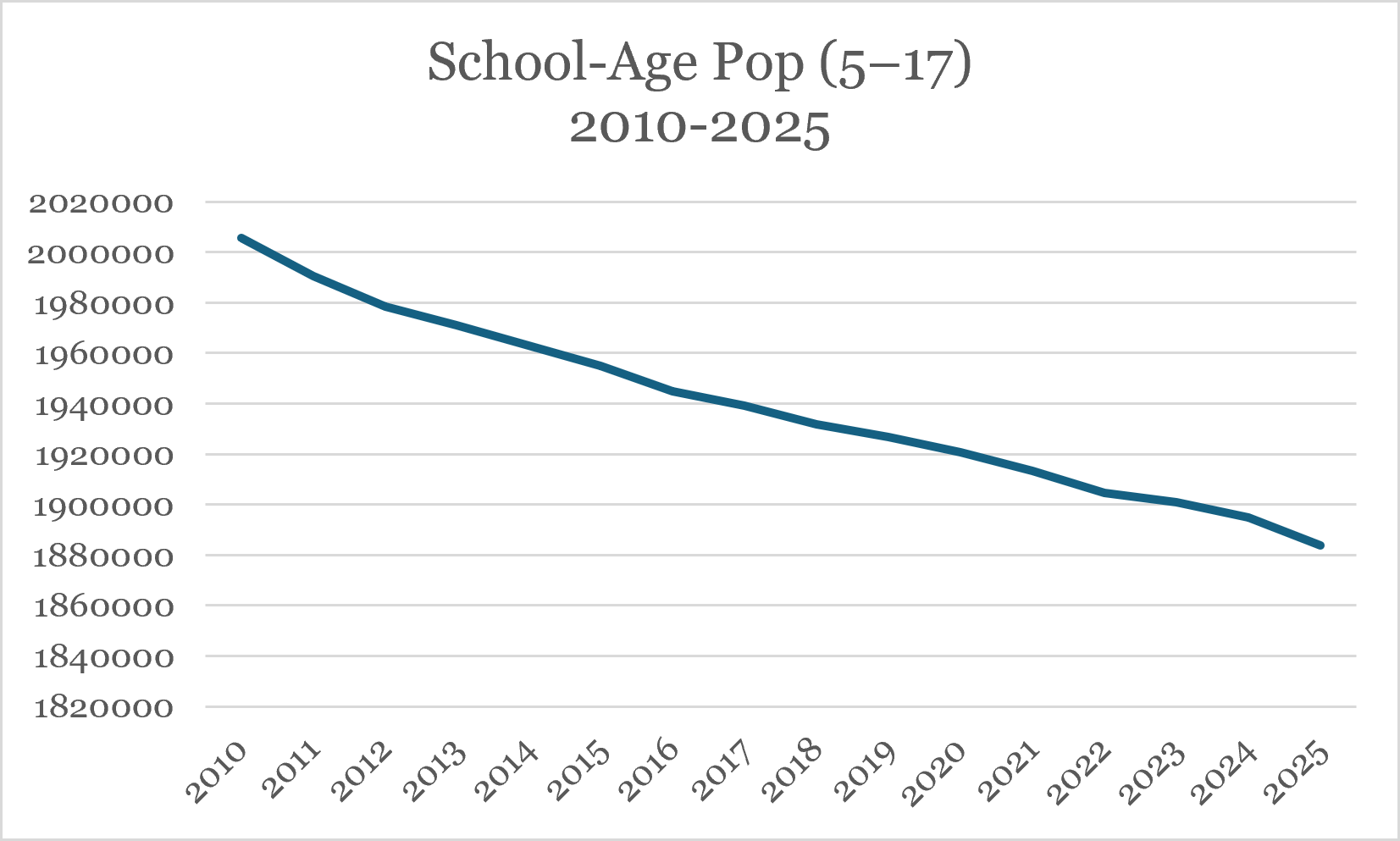
They look pretty similar, don’t they? The lines, I mean.
Nearly all the student population loss in Ohio’s public school districts can, in fact, be attributed to the loss in overall student population3.
So it’s not that families and students are abandoning public schools at all, actually, which is certainly what Kogan and others want you to infer. It’s that we have fewer kids today than 15 years ago.
Which brings me back to EdChoice. See, Kogan claims that public school advocates are arguing that EdChoice is draining kids from school districts and he claims those arguments are bunk.
Which would be true … if we were arguing that.
But we’re not.
Quite the opposite, in fact. From the beginning, we’ve been arguing that this money is simply subsidizing private school tuition for parents who can already afford to send their kids to private school because they are currently sending their kids to private schools — something proven by the private schools’ own presentations to parents explaining EdChoice, as I demonstrated in the Mustang Trilogy
This is a really long-winded way of saying he is simply misrepresenting our actual argument, which is that the money is being drained away from kids in public schools to pay for unconstitutional private school tuition subsidies.
Point #2: Vouchers have not caused a drop in funding for public school districts
This is what Kogan and his ilk simply do not understand, or (more likely) do understand but deliberately ignore:
State funding for EdChoice comes out of the same state funding pot that state funding for public school students comes from.
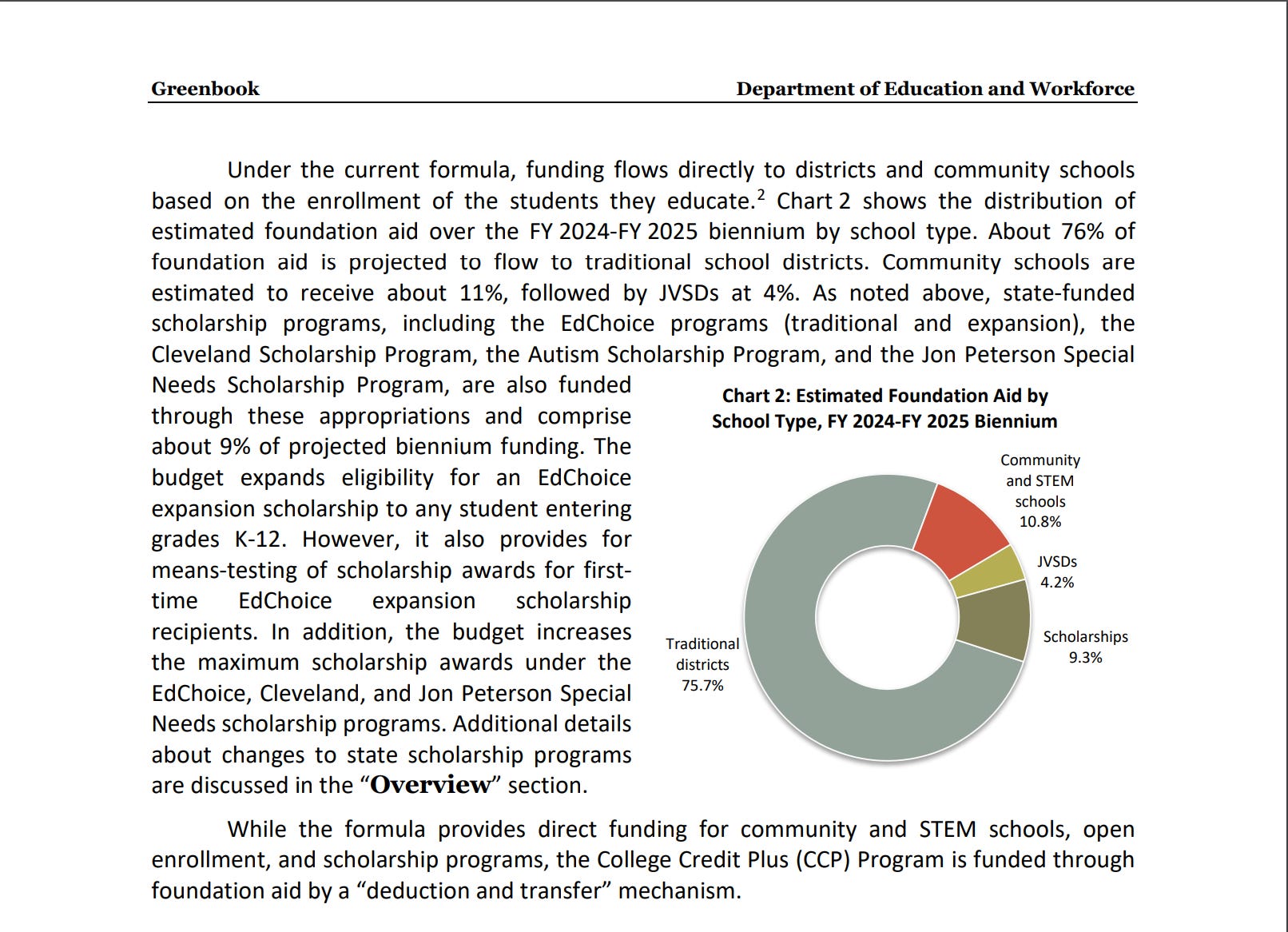
I don’t know how many times I have to repeat this, but this inconvenient fact is always ignored by these guys. Probably because they know it’s such a problem for them constitutionally.
If you are not fully funding the educations of public school students out of that pot (which the state is clearly failing to do), while you are exploding funding for unconstitutional private school tuition subsidies from that same pot, it’s a math problem.
THAT is what Judge Jaiza Page found compelling in her ruling last year calling EdChoice unconstitutional, not as Kogan so dismissively put it: “the mere possibility that voucher funding would’ve been redirected to public schools, no matter how unlikely, appeared to have been sufficient to convince Franklin County Judge Jaiza Page when she moved to block the EdChoice program last summer.”
No, buddy. It’s the fact that the money literally comes out of the same funding line that convinced Judge Page. But go ahead. Keep insulting the Judge’s intelligence. I’m sure that’ll go over great in court.
See, there’s no nebulous guessing here that voucher money would have otherwise been used to fund public school students.
It literally would have been … because it’s the same funding line!
Now if Kogan took one more step and started supporting funding these things out of their own line item, we might be getting somewhere. But somehow they never do quite get there, do they?
Point #3: School Districts underestimated how much state funding they would receive on their 5-year forecasts, so EdChoice hasn’t hurt them.
This is so silly, it’d be funny if it weren’t portrayed as Kogan’s big Gotcha! moment.
Ohio’s 5-year forecasts (which are ridiculous since state funding is only done on two-year cycles, but I digress) are estimates. And they are notoriously pessimistic. Why? Because school district treasurers have had it drilled into them to be conservative from birth, it seems. To be fair, this pessimism is due to the state screwing them over for so many years.
But is it surprising that a group of folks who are trained to be conservative and pessimistic in their estimates end up producing conservative and pessimistic estimates?
No.
In fact, it should be something for Kogan and his friends to champion as fiscally responsible!
Ohio’s five-year forecasts are bullshit, as any school treasurer will tell you. Because beyond the biennial budget, they are simply guessing. And the fact that state aid comes in higher than a conservative guess from five years earlier shouldn’t be a surprise to anyone.
Unless you’re an Ohio State PoliSci Prof, apparently.
Let’s look at the actual money, shall we, as I did a few weeks ago.
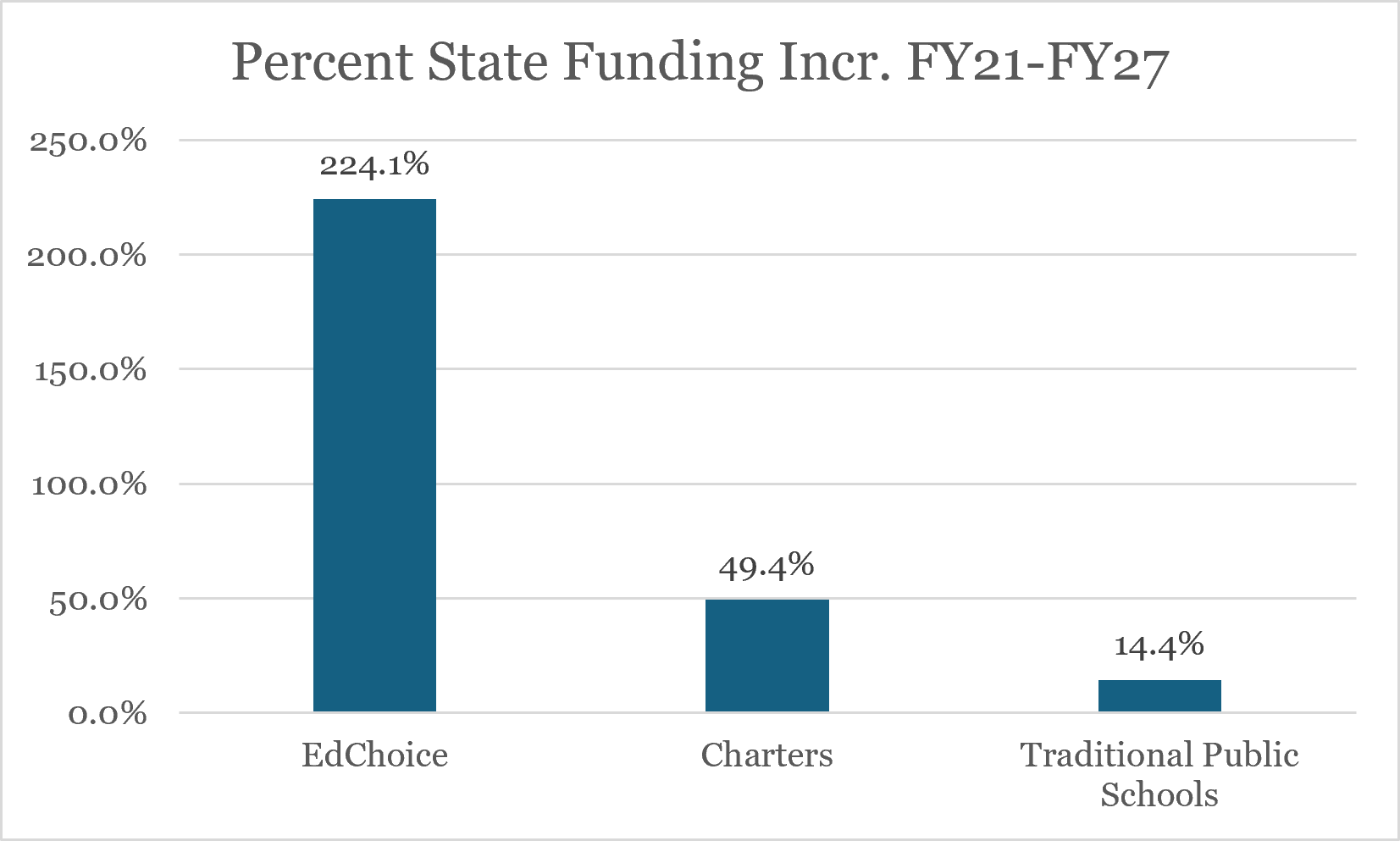
Remember that all these increases are coming out of the same pot of money!
Kids in public schools are getting 14.4 percent more state aid in 2026-2027 than they did in 2020-2021. But private schools are getting 224 percent more and Charter Schools are getting almost 50 percent more.
Just in terms of overall share of the state aid, kids in public schools will get about 72 percent of the state aid this school year.
Mind you, kids in public schools make up 83 percent of students enrolled in all Ohio educational settings. And they only get 72 percent of the money the state spends on K-12 education.
In 2020-2021, they got about 80 percent. Still less than their enrollment share, but a little better.
The inflation rate since 2020-2021 is 28%.
That means that the state of Ohio has kept up with about half the inflation rate for kids in public school districts.
But please, Prof. Kogan, tell me more about how 5-year forecasts coming in under actual funding levels proves that state aid is working out great for kids in public schools?
Point #4 Public School Employment is up while enrollment is down
Another bullshit Gotcha! here.
Let’s dispense of this argument with a little bit of math, shall we?
Ok. The average Ohio school district had 2,798 students in 2010. The average Ohio school district had 2,453 students in 2025. So that’s a drop of 345 students. Let’s assume each district has 13 grades for K-12. So that’s 26.53 students per grade.
Kogan’s argument is this: there should be an employment drop commensurate with the enrollment drop.
See, here’s the thing the OSU Prof misses: those 26.53 students are, um, spread throughout the grade!
So depending on how many classrooms of students you have, that could be as few as 2 or 3 students per classroom, or maybe as many as 5 or 6.
So let’s say it’s the larger number for argument’s sake and you lop off a teacher per grade. The average number of teachers per school district in 2010 was 173 — a reminder that 173 teachers was understaffed in 2010, according to the state’s own funding formula. So now you have, what, maybe 6-12 fewer teachers, depending on the already understaffed school district?
Is that going to have the massive ripple effect on the administrative need that Kogan seems to think it should? Are you having to close buildings because you lose a classroom worth of students in each grade in an already understaffed building?
Again, it depends on the district.
But on average? No.
And this gets back to what I mentioned earlier — his assumption that we had employment levels right in 2010. We did not. The state’s formula then had a $3 billion shortfall (about $4.5 billion in inflation adjusted dollars). So if we were understaffing public education in 2010, we’re certainly not overstaffing it now, even if overall employment has slightly ticked up.
Let’s look at the expenditure data to test this, shall we?
If you look at what school districts spent per equivalent pupil in 2012 (the state didn’t use the Expenditure Flow Model until then) vs. 2025, what you’ll find is that, adjusted for inflation, overall spending was up about 10 percent, but that wasn’t driven by a spike in administrators, as Kogan and others try implying all the time.
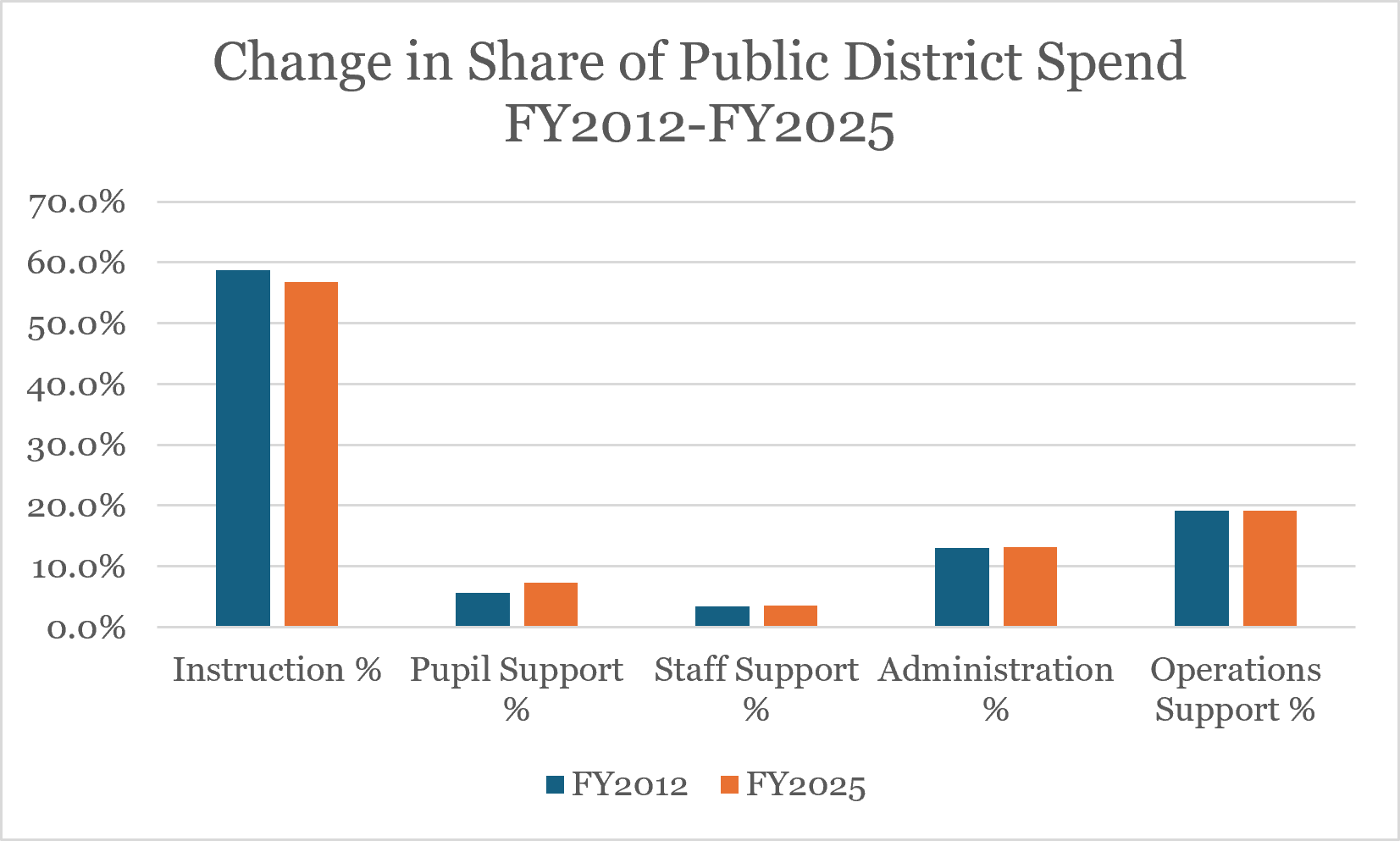
More than half of the increase can be accounted for in Pupil, Staff and Operations Support Services increases. The largest single dollar increase was still in Instruction, though. Administrative costs grew at the second smallest dollar amount during the period.
The bottom line is that a small percentage of the expenditure pot has been removed from instruction and re-allocated to pupil support services (counseling, health, psychologists, etc.). Everywhere else, the share of the spend remained pretty much the same as it was 15 years ago.
So his argument, both stated and implied, that school districts are bloated because they have more employees despite having fewer students and more of those employees are administrators, is simply bunk.
Again, I’d be remiss if I didn’t mention here that the Fair School Funding Plan — the state’s own funding formula — says the state is spending $2.7 billion less than what students need, even with enrollment drops.
How could that be, you ask? Because we’ve never properly staffed or funded public education, as the Ohio Supreme Court has ruled four different times.
But, like Kogan, let’s ignore that rather major point.
How districts are spending money hasn’t changed much during that period, and if anything they’ve had to sacrifice some instructional spend to improve student support (or wraparound) services.
And how has all of this been paid for? With larger and more frequent property tax levies because the state is underfunding its own formula to pay for unconstitutional private school tuition subsidies for millionaires. That’s what happens when you take nearly $2.5 billion from the pot meant to fund public school students and instead send it to privately run charter schools and unconstitutional EdChoice private school tuition subsidies.
It’s really quite simple, I think.
One more thing: As the parent of a fourth-year Ohio State Engineering student, I sure am glad he’s not in PoliSci.
If you want to get nuts, though, have at it: https://education.ohio.gov/getattachment/Topics/Data/Report-Card-Resources/Traditional-Report-Cards/Financial-Data-Technical-Document.pdf.aspx?lang=en-US
I refuse to call the Department by its new name.
Claude put the correlation at r=0.98